
UAE E-Invoicing Requirements Explained: What Every Business Needs to Do Before 2027
Understanding the official UAE E-Invoicing Requirements is critical as the UAE’s e-invoicing mandate has just gone through its first real deadline shift — the deadline to appoint an Accredited Service Provider (ASP) was extended from 31 July to 30 October 2026. On its own, that sounds like relief. It isn’t, quite. The mandatory go-live date for large businesses is still 1 January 2027, which means the extension didn’t buy more time overall — it compressed the gap between appointing a provider and actually being live from roughly five months down to two.
Who Must Comply with UAE E-Invoicing Requirements?
| Business Category | ASP Appointment Deadline | Mandatory Go-Live Date | Scope / Detail |
| Large Businesses (≥ AED 50M) | 30 October 2026(Extended) | 1 January 2027 | B2B & B2G (Mandatory) |
| Businesses (< AED 50M) | 31 March 2027 | 1 July 2027 | B2B & B2G (Mandatory) |
| Government Entities | – | 1 October 2027 | All Government Invoicing |
| B2C Transactions | Excluded | Excluded | Currently Out of Scope |
Meeting all official UAE E-Invoicing Requirements ensure that free zone and mainland companies remain fully compliant. Businesses with revenue of AED 50 million or more must appoint an ASP by 30 October 2026, with mandatory e-invoicing from 1 January 2027. Businesses under that threshold have until 31 March 2027 to appoint an ASP, with mandatory e-invoicing from 1 July 2027. Government entities follow from 1 October 2027. The mandate covers all B2B and B2G transactions — it applies whether or not you’re VAT-registered, and free zone businesses are in scope. B2C transactions are excluded, for now.
Core Technical UAE E-Invoicing Requirements Explained
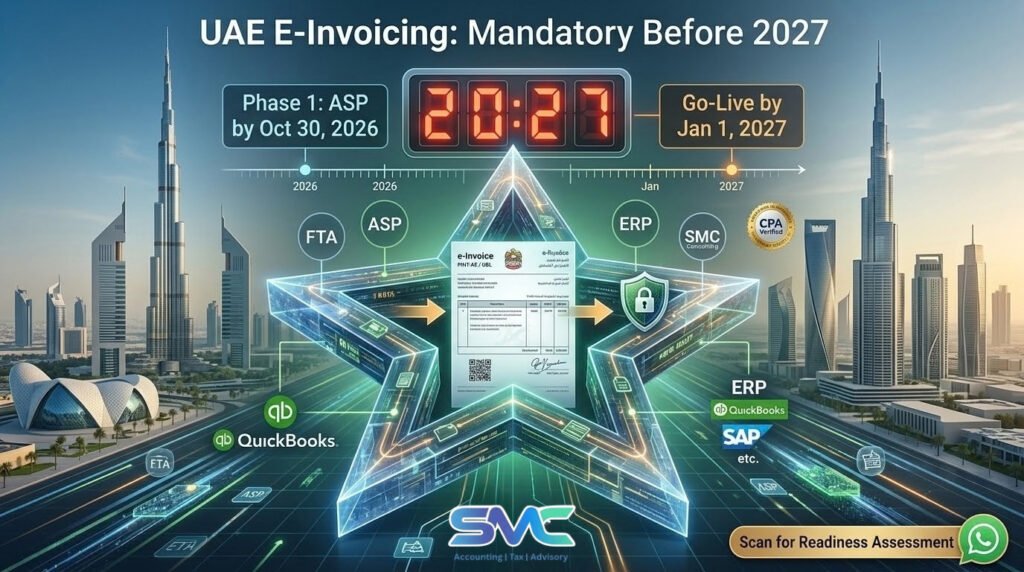
A structured XML file — built to the Peppol PINT-AE or UBL standard — not a PDF, not a scanned invoice, not an emailed invoice that simply looks the same as before. It moves through an FTA-Accredited Service Provider using what’s called the five-corner model: your system, to your ASP, to the FTA, to the buyer’s ASP, to the buyer’s system. Invoices need a digital signature and bilingual Arabic and English data, records must be retained for at least five years, and if your system fails and invoices can’t be transmitted on time, the FTA has to be notified within two business days. Non-compliance penalties run up to AED 5,000 a month, under Cabinet Decision No. 106 of 2025.
“Do I need a new ERP?” — usually not
Most existing systems — QuickBooks, Tally, Odoo, SAP, Oracle, and similar — can stay in place, provided they can connect to an ASP and produce the required XML output with a digital signature. The gap is rarely the accounting system itself. It’s usually the data feeding it: incomplete vendor and buyer master data, inconsistent invoice numbering, or manual invoicing processes sitting outside the system altogether. That’s the part worth assessing now, while there’s still runway. Adapting your ERP workflows early makes fulfilling the UAE E-Invoicing Requirements much simpler before the mandatory phase begins.
What the compressed timeline means in practice
For a Phase 1 business, the realistic sequence is: assess current invoicing and system readiness, clean up master data, select and appoint an ASP by 30 October 2026, then integrate, test, and go live by 1 January 2027. Two months between appointing a provider and being fully live is workable if the groundwork — data cleanup, process mapping — is already done by the time the ASP is chosen. It is not workable if ASP selection is where the work starts.
If your business crosses the AED 50 million threshold, the ASP decision needs to happen in the coming weeks, not the coming months. If you’re under that threshold, you have a genuine head start most of your competitors aren’t using yet — the businesses that start their readiness assessment now, rather than in early 2027, will spend far less doing it. Book a free e-invoicing readiness assessment and we’ll tell you plainly where the gaps actually are.
Key Steps to Meet UAE E-Invoicing Requirements Seamlessly
To ensure seamless integration before the statutory cut-off dates, businesses should conduct an early technical audit of their enterprise resource planning (ERP) systems. Standardizing billing data formats, confirming FTA-compliant cryptographic stamps, and validating real-time XML processing capabilities will prevent last-minute operational disruptions and heavy non-compliance penalties under UAE tax regulations.