

E-Invoicing in UAE: How It Works, Implementation Steps, Challenges & CFO Insights
Introduction
E-Invoicing in UAE is moving toward a fully digital tax ecosystem through the introduction of E-Invoicing. This is not just a regulatory update — it is a major transformation in how businesses create, process, and report financial transactions.
E-Invoicing in UAE will impact every business operating in the UAE, especially in terms of VAT compliance, ERP systems, internal controls, and financial reporting. In this article, we explain how E-Invoicing works, what companies must do before implementation, key steps, common challenges, and strategic CFO-level insights.
How E-Invoicing in UAE Works (5 Corners Model)
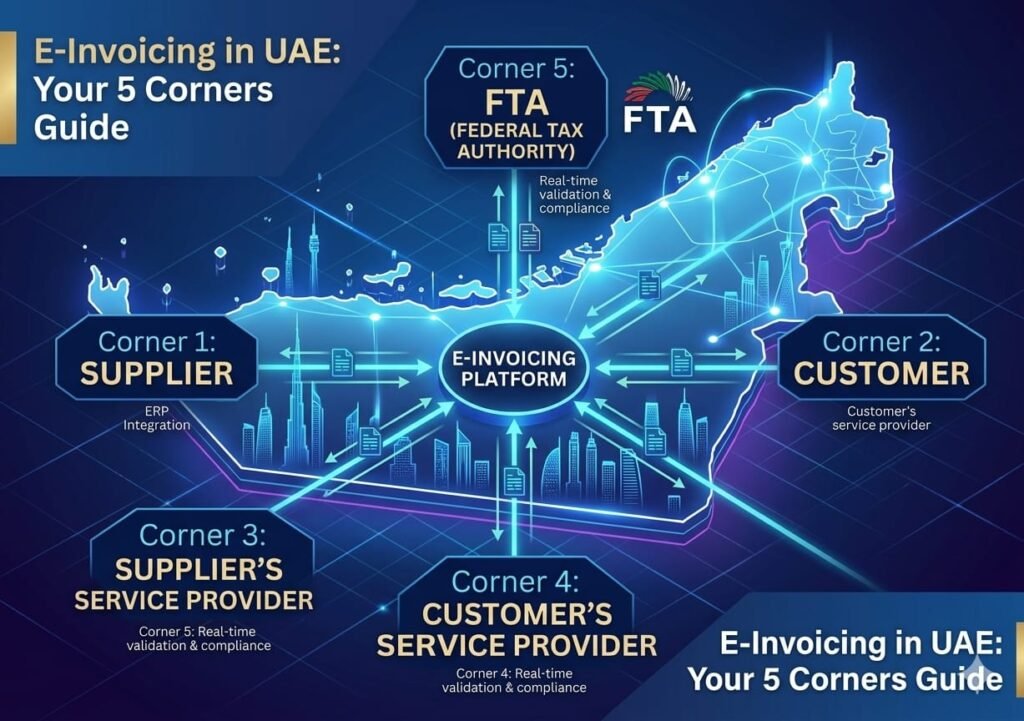
E-Invoicing in UAE operates through a highly structured ecosystem designed for real-time validation, transparency, and full traceability of every transaction. This framework is governed by the 5 Corners Model:
| Structure | Entity / Layer | Core Function & Operational Role |
| Corner 1 | Supplier ERP System | The transaction originates here. The invoice is generated electronically in a standardized structured format (e.g., XML) within the supplier’s billing system. |
| Corner 2 | Application Service Provider (ASP) | Acts as the secure transmission bridge. The ASP validates the invoice format and securely transmits it to the central tax platform. |
| Corner 3 | Federal Tax Authority (FTA) | The clearinghouse. The central platform checks the invoice in real time against VAT compliance rules, registers it, and generates a unique reference number. |
| Corner 4 | Buyer ERP System | The recipient layer. The validated, compliance-approved invoice is received directly by the buyer’s system for automated processing and matching. |
| Corner 5 | Audit & Storage Layer | The historical record. Digital footprints, cryptographic hashes, and transaction details are permanently stored for future reporting, analytics, and tax audits. |
What Companies Should Do Before E-Invoicing in UAE Implementation
Before initiating technical integration for E-Invoicing in UAE, organizations must build a solid operational foundation. The table below outlines the critical preparation areas required to eliminate transition risks:
| Foundational Pillar | Key Pre-Implementation Action Items |
| ERP Capability Check | Assess if the current software architecture can handle automated data exchanges, schema structures, and external API configurations. |
| Process Assessment | Map out the existing invoicing, approval, and VAT tracking workflows to identify processing bottlenecks. |
| Master Data Cleansing | Standardize client and supplier databases, verification procedures, tax registration numbers (TRNs), and core transaction codes. |
| Cross-Functional Alignment | Form a dedicated project group bridging Finance, IT, Compliance, and Operations to streamline decision-making. |
| Regulatory Upgrades | Deep-dive into specific FTA technical specifications, compliance parameters, and reporting mandates. |
Key Steps in E-Invoicing in UAE Implementation
A structured, phase-gate methodology ensures that systems maintain extreme accuracy and operational stability during the E-Invoicing in UAE go-live phase:
| Phase | Step-by-Step Implementation Framework |
| Phase 1: Diagnosis | Conduct an E-Invoicing readiness assessment and detailed gap analysis across data structures and existing ERP capabilities. |
| Phase 2: Architecture | Formulate technical designs mapping out specific tax logic, process structures, data mappings, and ASP integrations. |
| Phase 3: Integration | Configure ERP systems, set up live transmission protocols with ASPs, and align APIs to coordinate smoothly with tax networks. |
| Phase 4: Validation | Execute rigorous end-to-end user-acceptance testing (UAT), stress testing, and syntax validations across varied transactional cases. |
| Phase 5: Deploy | Conduct thorough user training, initiate corporate change management protocols, deploy systems to production, and monitor live performance. |
Common Challenges in Implementation
Transitioning to a real-time ecosystem for E-Invoicing in UAE introduces potential roadblocks that businesses must proactively mitigate:
- Poor Master Data Quality: Incomplete records, lack of TRNs, or unverified address fields trigger automatic system rejections.
- System Limitations: Legacy ERP platforms often lack the flexibility to generate modern file formats or seamlessly connect via APIs.
- Siloed Finance & IT: Implementation delays occur when finance compliance rules are poorly communicated to technical IT developers.
- Flawed Tax Mapping: Misconfiguring VAT rules within billing modules leads to structural compliance calculation failures.
- User Resistance: Staff unfamiliar with real-time automated verification patterns can introduce operational delays during deployment.
Import, Export & Cross-Border Transactions
Cross-border data points demand absolute alignment with external frameworks to preserve reporting integrity:
- Imports: Transactions must systematically integrate with customs declarations. VAT handling remains tied to Import VAT procedures or standard Reverse Charge Mechanisms (RCM). All electronic parameters must validate perfectly against custom logs and Harmonized System (HS) commodity codes.
- Exports: Outbound invoices are structured as zero-rated transactions for local VAT purposes. However, compliance frameworks require automated links connecting the invoice to digital transport manifests and verified customs clearance exports.
- Multi-Currency Transactions: While transaction generation can occur in any global currency, financial values must execute an automated conversion step. The system must convert totals directly into United Arab Emirates Dirhams (AED) utilizing official, approved central exchange rates at the point of creation. Accuracy in conversion is vital to ensure proper ledger balancing.
ASP vs Consultant – What’s the Difference?
Executing a flawless transformation requires a distinct separation of technical capability and strategic design:
| Feature Set | Application Service Provider (ASP) | Strategic Advisory Consultant |
| Primary Focus | Technical integration, data formatting, and pipeline transmission. | Operational architecture, structural tax design, and change management. |
| Core Mandate | Establishes the digital pipeline between your ERP and the FTA platform. | Ensures business logic, accounting rules, and internal workflows are fully optimized. |
| Key Deliverable | Data conversion, digital validation signatures, and API connectivity. | Gap analysis, tax mapping matrices, operational SOPs, and internal control designs. |
CFO Perspective: Why E-Invoicing Matters
For forward-thinking CFOs, E-Invoicing shifts from a regulatory compliance obligation to a profound finance transformation initiative. It unlocks institutional advantages including:
- Instant Financial Visibility: Eliminates end-of-month consolidation lags through real-time balance tracking.
- Strengthened Internal Controls: Enforces automated cryptographic integrity across accounting ledgers.
- Flawless VAT Integrity: Minimizes audit tracking exposures via pre-validated processing rules.
- Operational Automation: Eradicates slow manual entry processes, lowering error rates across the enterprise.
- Agile Strategy Formulation: Empowers executive teams with high-fidelity, instantaneous working capital insight.
Conclusion
E-Invoicing in UAE is not simply about changing invoice delivery formats. It represents a foundational shift toward an interconnected, transparent financial ecosystem. Firms that move decisively during these structural changes protect operational continuity and secure immediate competitive, strategic, and financial advantages.
Ready to streamline with Al SMC your billing system for full compliance? Don’t let new regulations disrupt your corporate operations or risk heavy FTA penalties. Check out our comprehensive business solutions on our Services Page to see how we support finance teams, or click here to Chat with our experts on WhatsApp for an instant strategy consultation today.